
8AM Journal · 3 min read
What is shilajit good for? Reading the evidence
A straightforward way to assess benefit claims: look at the people, preparation and outcome behind each headline.
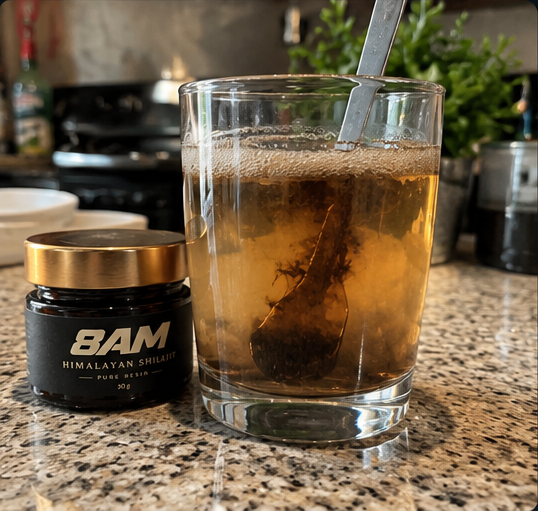
A positive study result can be meaningful without proving a broad wellness promise. Match each claim to the outcome actually measured.
Begin with an answerable question
“Is it good for you?” is too broad to test in a single study. Researchers need a defined outcome: a blood marker, a strength measurement or a change in bone density. Those outcomes are useful, but they are not interchangeable.
When you see a benefit claim, ask what success would look like and whether the cited research measured that exact result. An attractive explanation of how an ingredient might work is a starting point for investigation, not a finished answer.
Three areas researchers have explored
Human trials have examined testosterone markers in middle-aged men, strength retention after a fatigue protocol in active men, and bone density in postmenopausal women with osteopenia. These are separate research questions, with different participants and preparations.
For a closer explanation, read our guides to shilajit benefits for men and shilajit benefits for women. The original papers are linked below so you can see the study context.
Use four checks when reading a claim
- People: Were the participants similar to the people the claim is aimed at?
- Preparation: What exact extract or product was tested, and how was it used?
- Comparison: Was there a placebo or another suitable comparison group?
- Outcome: Was the result something people felt or experienced, a laboratory marker, or a finding in only part of the group?
Then ask how long the research lasted and whether other studies support the same conclusion. This approach makes a narrow but useful result easier to recognize.
Quality evidence and benefit evidence
A product test may report ingredient characteristics or contaminant measurements. A clinical trial asks what happened to people receiving a particular preparation. Both can be useful, but they solve different problems.
For a purchase, request documentation that matches the product and batch. For a health claim, look for relevant human research. A photograph of a certificate, a high percentage on a label or an appealing origin story does not by itself establish a clinical benefit.
What this means for an 8AM routine
The studies discussed here are not trials of 8AM products. We do not treat their findings as proof that our resin or honey sticks produce the same outcomes. Our format choice is straightforward: resin for preparing a warm drink, or honey sticks for a portable, sweet option.
Choose based on the label, your dietary preferences and your circumstances. Follow the product directions and seek professional advice when a health condition, medication or persistent symptom is part of the decision. There is no need to turn curiosity about a supplement into a promise about your future health.
Sources & further reading
Testosterone markers: Pandit et al., 2016
Fatigue-related strength: Keller et al., 2019
Bone density: Pingali and Nutalapati, 2022
Educational content from 8AM. This guide is not medical advice. Research findings do not establish the same effects for 8AM products, which are not intended to diagnose, treat, cure or prevent disease.
Make it your own
Two formats. Your choice.
Explore the ingredients and preparation that fit your day.
Explore pure resinExplore honey sticks